
Alger County Parole or Probation
Michigan parole and probation records for an Alger County case are maintained through the Michigan Department of Corrections Field Operations Administration, not by the Alger County Sheriff. The MDOC Offender Tracking Information System, commonly called OTIS, can display a current status such as parole, probation, discharged, or absconder. It may also identify an assigned location or supervision office. The Michigan Parole Board decides parole for eligible state prisoners. A sentencing court orders probation, while MDOC field staff administer community supervision in the cases shown by OTIS.
Parole and probation both involve rules in the community, yet their legal starting points differ. A parole date documents release from prison into conditional MDOC control. Probation is a court sentence that can begin without a prison term. Neither label means the case has ended. Final discharge is the later event that ends MDOC jurisdiction for that sentence, although separate court duties can remain.
| Record point | Parole | Probation |
|---|---|---|
| How it begins | Release from prison under MDOC control | Court-ordered community supervision |
| Decision maker | Michigan Parole Board for eligible prisoners | Sentencing court |
| Key OTIS fields | Date Paroled, status, assigned location, supervision dates | Probation status, sentence record, assigned location |
| How it ends | Discharge from MDOC jurisdiction | Discharge after the probation term or a court action |
- Parole
- Permission to leave prison while the sentence continues under MDOC custody and control.
- Probation
- A court-ordered period of supervision in the community.
- Discharge
- The recorded end of MDOC jurisdiction or supervision for the sentence.
- Absconder
- A supervision status alleging that a person is no longer available to the supervising authority.
Check Alger County Post-Release Supervision
The strongest public verification begins with identity, not status. OTIS can contain people with similar names and can show several active and inactive sentences on one profile. Compare the MDOC and SID identifiers, sentencing county, court file number, offense, age, aliases, and physical details before reading the status. An inactive sentence marked discharged does not cancel a separate active sentence. The profile status and each sentence entry must be read together.
- Open the official OTIS landing page, read its coverage limits, and launch the search.
- Search by MDOC number when known. Otherwise use the exact name plus enough facts to separate similar results.
- Confirm the person through sentence county, court file number, aliases, age, offense, and identifiers.
- Read the profile status before any date. Then note Date Paroled, supervision begin and discharge dates, and Assigned Location.
- Use the official MDOC Region 1 office directory to verify the listed office and contact route.
- For durable proof, request the relevant parole order, discharge certificate, or MDOC record through MDOC FOIA.
OTIS covers people currently supervised by MDOC and people discharged within its public post-discharge window. It excludes county-jail-only sentences. A person released from Alger County Jail after bond, dismissal, or a jail sentence may have no OTIS entry. For that path, the Sheriff release record and the court order are the proper sources. The broader Alger County released inmate search explains how those local records fit together.
Note: A Date Paroled marks the prison-to-community event; a supervision discharge date is a later endpoint and must not be treated as the prison exit.
Alger County Supervision Office Details
The local field contact in MDOC's directory is Alger County Parole/Probation. It can be the operational office for a person assigned there, but the county of conviction, an old home address, or earlier confinement at Alger Correctional Facility does not establish the current office. Check the OTIS Assigned Location first. Field assignments can change, and the office can disclose only information permitted by law and agency policy.
Alger County Parole/Probation
101 Court Street
Munising, MI 49862
Phone: 906-387-7021
For parole-board correspondence, MDOC's published contact is the Michigan Parole Board, P.O. Box 30003, Lansing, MI 48909, phone 517-373-0270, and fax 517-335-0039. Public correspondence becomes part of the offender file. A focused inquiry should identify the person and the record sought. The Board and the local field office serve different roles: the Board makes parole decisions, while the assigned office manages community supervision.
Correct Alger County Supervision Records
Alger County users have a specific correction fork when an OTIS fact appears wrong. Court-derived facts, such as the conviction, sentence, or court file information, should go first to the sentencing court. Supervision-derived facts, including an assigned office or absconder-related status, should go to the supervising MDOC office. The MDOC frequently asked questions explain that MDOC updates OTIS when the proper court order or supervising-agent direction supports the change.
A general complaint to the public search interface does not replace the source correction. Keep a copy of the OTIS profile, note the access date, and identify the exact field at issue. Then provide the court or field office with the relevant case number and supporting government document. OTIS removal is different from factual correction. MDOC states that removal generally follows a set-aside, expungement, or another legal rule; an ordinary disagreement with a public field does not erase the record.
Alger County Absconder Status
No verified Alger County absconder list is published. MDOC instead uses statewide OTIS status codes and its Absconder/Escapee Tip Line. The OTIS About material distinguishes a parole absconder status from a probation absconder status. The first concerns a person sought by MDOC while on parole. The second concerns a probation absconder under the sentencing county's jurisdiction. In either case, the label alleges a failure to remain available or comply with supervision. It is not proof of a new conviction or a final court finding.
A person with location information should contact law enforcement or the MDOC Absconder/Escapee Tip Line at 517-755-0855. Do not approach the person. For a record question, check the current OTIS profile and assigned office rather than relying on an old screenshot. A warrant or violation process can affect supervision and the sentence timeline, but the precise consequence depends on the official action and case record.
Note: An absconder label is an active supervision concern, not a clean discharge and not proof that every reported allegation has been adjudicated.
Alger County Supervision Conditions
Parole and probation conditions are case-specific. Common records may address reporting, travel, treatment, contact, residence, or other conduct, but no generic list can establish one person's duties. Read the parole order, probation order, OTIS supervision information, and agent instructions for that case. A parolee remains under MDOC custody and control under MCL 791.238; parole is permission to leave prison, not discharge from the sentence.
A suspected violation can lead to investigation, a warrant, custody, or further process. It does not automatically establish a new conviction. A parole-violation warrant can affect the sentence clock, and a grant of parole can be suspended or rescinded before physical release if new information or misconduct arises. Verify the current status through OTIS and the assigned office. MI-VINE may provide a custody-change alert, but it is not the supervision order or the final violation record.
Alger County Parole Decision Records
Michigan does not publish a searchable county calendar for every ordinary parole interview. The state's public-hearing material largely concerns lifer, commutation, and pardon matters announced through individual releases. The public-hearing registration page serves those announced proceedings, not a rolling list of all Alger County or Alger Correctional Facility cases. Routine decisions are generally made by a panel, while lifer matters follow full-Board rules.
A grant, denial, and deferral have different meanings. A grant still requires release preparation and does not prove that the person has left prison. A denial normally leads to a later review date. A deferral can allow more planning or treatment and is not a release. MDOC's Parole Board Decisions Reports provide aggregate figures, not an individual results search. For one person, use OTIS, an authorized notice, the official case file, or a targeted MDOC request.
The official MDOC legislative reports page below is the source for those statewide aggregates.
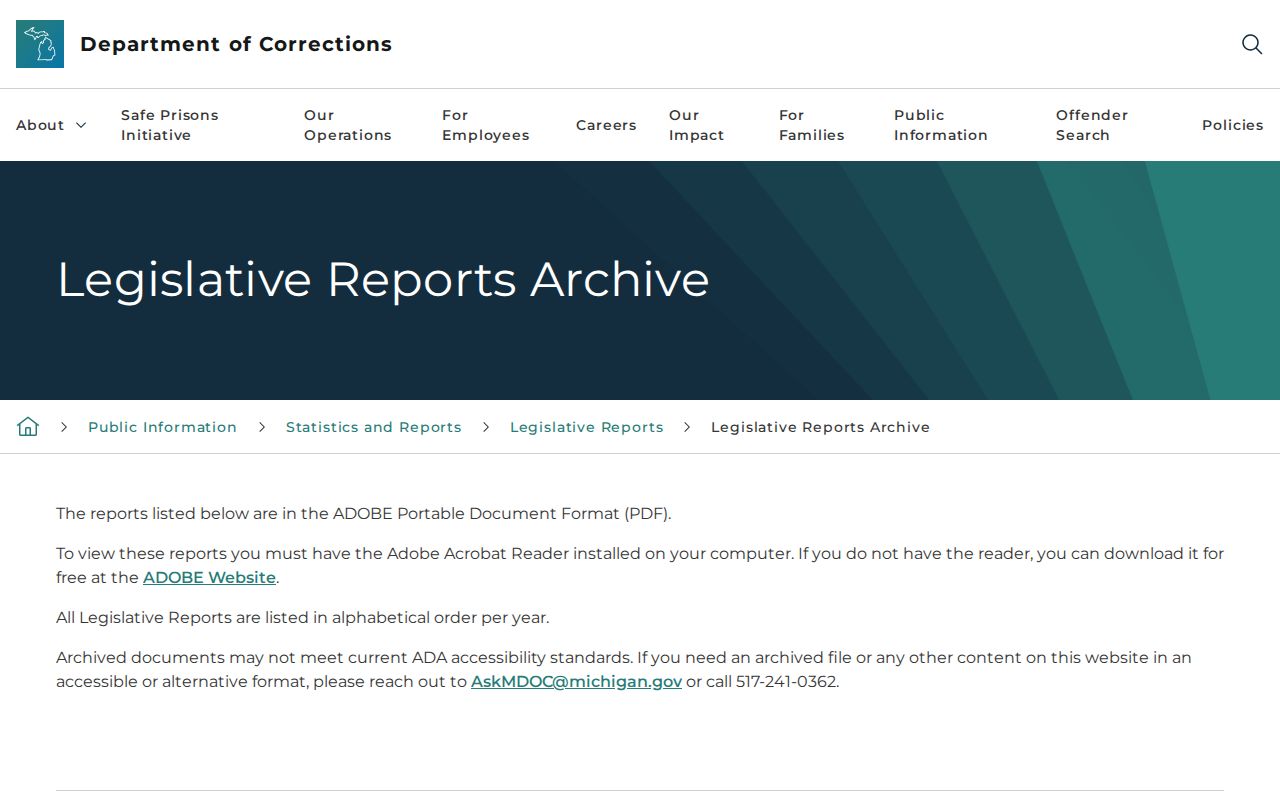
The report page helps explain systemwide outcomes, but it cannot confirm a named person's interview, decision, release, or Alger County field assignment.
When Alger County Supervision Ends
Discharge is the key end point. In OTIS, a discharged profile means MDOC no longer has jurisdiction for the recorded path, whether supervision ended after parole or probation, the maximum sentence expired without parole, or another documented route applied. For a parolee, Date Paroled and Discharge Date answer different questions. The first marks the move from prison to the community. The second marks the end of MDOC control.
Capture the profile-level Discharge Date, any sentence-level discharge date and reason, and the relevant identifiers. If official proof is needed, request the discharge certificate rather than treating a screen capture as a certified record. MDOC's FAQ describes a broader prisoner packet, sometimes called a PENPACK, that may contain a judgment, parole material, a photograph, fingerprints, and a discharge certificate, subject to access rules and redaction. A narrow request for the certificate or date fields is usually clearer.
Discharge from MDOC does not erase the court file or prove that every separate obligation ended. It does establish that the named MDOC supervision path reached its recorded end. When another active sentence appears on the same profile, read that entry independently before drawing a conclusion.