
Alger County Scheduled and Actual Dates
A scheduled date is the agency's present calculation. An actual release date records what happened after processing. Michigan OTIS does not promise a single projected gate date. Its terms are Earliest Release Date and Maximum Discharge Date. The earliest date usually marks completion of the judicial minimum and the point at which the Michigan Parole Board first has jurisdiction in an ordinary indeterminate sentence. The maximum date is the sentence endpoint if parole does not occur earlier. Both fields can appear at the same time.
Neither field should be read alone. A favorable parole decision still requires release preparation and can be suspended or rescinded before release. A transfer between prisons leaves the person in MDOC custody. By contrast, Date Paroled records the transition to community supervision, and Date Discharged records the later end of MDOC jurisdiction. For the county jail, the court order supplies legal authority while the Sheriff's release entry supplies the actual exit time.
Find an Alger County Inmate Date
Start from the last known custodial agency. OTIS excludes county-jail-only prisoners and people sentenced only to jail. The Alger County Sheriff does not calculate an MDOC prisoner's minimum and maximum dates. A court docket can show the sentence, bond, or release order, but it may not show when physical processing finished. These boundaries prevent a court date, roster disappearance, or prison transfer from being mistaken for community release.
- Identify whether the person is in Alger County Jail, Alger Correctional Facility, another MDOC prison, or another agency's custody.
- For a state prisoner, open the MDOC OTIS landing page and launch the official offender search.
- Match the person by MDOC number, sentence county, court file number, age, aliases, offense, and other identifiers.
- Read status first, then Earliest Release Date, Maximum Discharge Date, Date Paroled, and any discharge fields.
- For a county sentence, contact the Alger County Sheriff and the proper court clerk for the jail credit, sentence, holds, and release order.
- When documentary proof matters, request the Sheriff release entry or an MDOC parole order or discharge certificate.
A pretrial detainee does not have a sentence-based date to calculate. Bond may be posted, a court may change the order, charges may be dismissed, or another hold may prevent release. Search MiCOURT for the judicial action, then verify physical custody with the jail. The full Alger County released inmate lookup connects the court, Sheriff, transfer, and release-record paths.
When a displayed date appears wrong, send the issue to the office that created the underlying fact. A sentencing error or incorrect court file detail belongs with the sentencing court. A supervision field belongs with the assigned MDOC field office. The agency can update OTIS after receiving the proper court order or supervising-agent direction. Keep the record identifier, access date, field name, and supporting order together. A source-specific correction is more effective than asking the public search interface to recalculate a sentence without its official inputs.
The official OTIS pages show how the Michigan offender search starts. The MDOC search overview below also states its public coverage and exclusions.
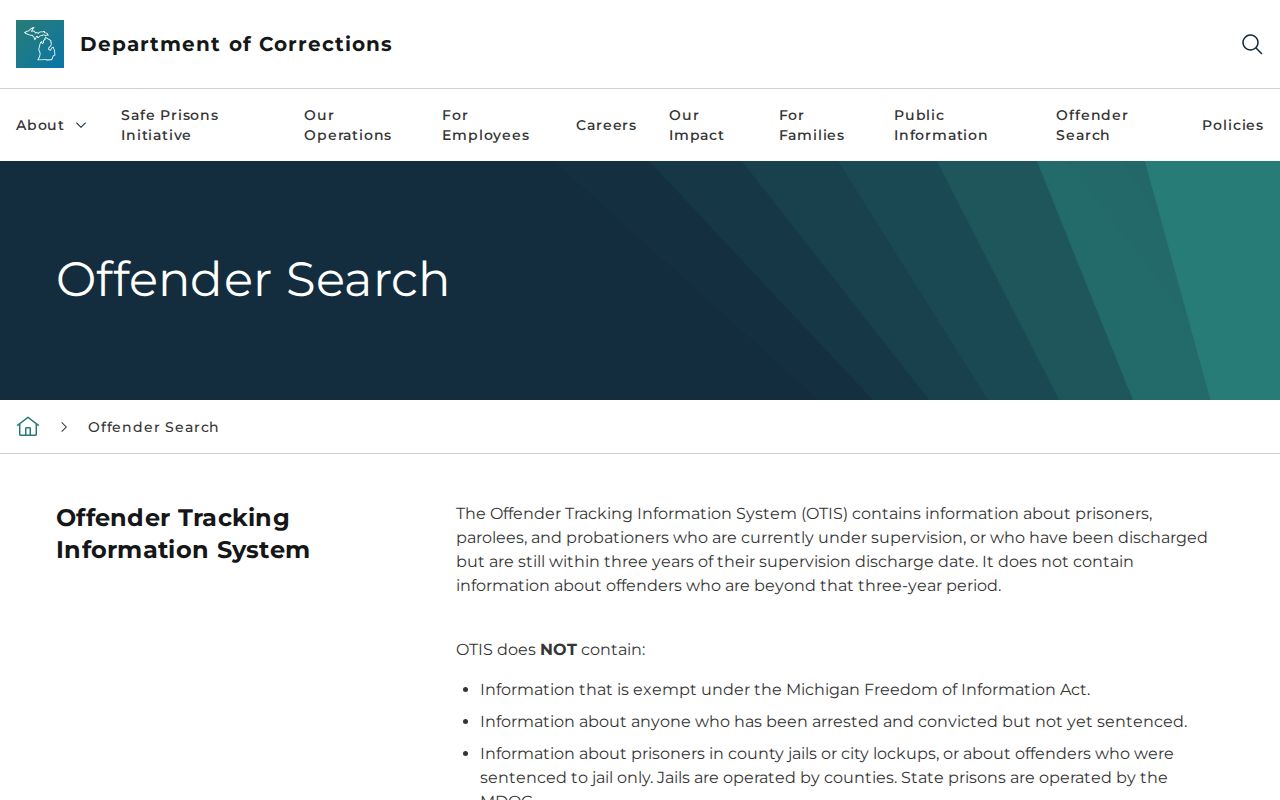
This interface is the state-prison route. It is not a live Alger County Jail roster and should not be used for a jail-only sentence.
Read Alger County OTIS Date Fields
An OTIS profile can contain more than one sentence. One inactive sentence may show discharge while another remains active. Record the MDOC and SID identifiers, sentence county, court number, offense date, sentence date, minimum, maximum, and conviction type. Then connect each date to the status and sentence row it belongs to. The profile status controls the present MDOC relationship; a single sentence-level label must not override it.
| OTIS field | What it establishes |
|---|---|
| Earliest Release Date | The usual first Parole Board jurisdiction point, not promised release |
| Maximum Discharge Date | The maximum sentence endpoint if release on parole does not occur sooner |
| Date Paroled | The prison-to-community transition or conferral of parole status |
| Supervision Discharge Date | The expected end of community supervision, not prison exit |
| Date Discharged | The recorded end of MDOC jurisdiction for the identified path |
| Assigned Location | The prison or field office tied to the current record |
The live OTIS offender search form supports name and identifier searches with added filters. Its screen is shown below so the county and state routes are not confused.
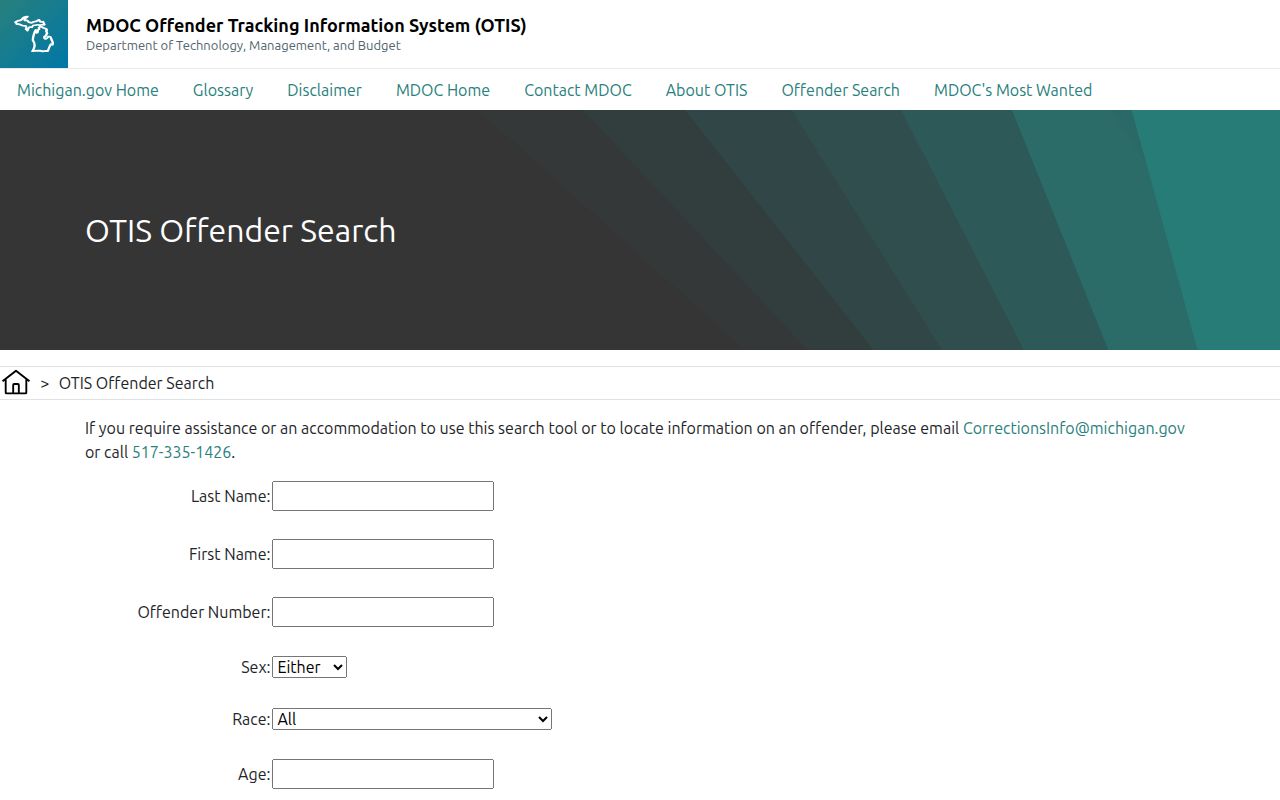
Search breadth and public data can change. Note the access date and preserve the official record when a date must be documented later.
Two Alger County Date Calculations
Alger County has two distinct calculation regimes. An eligible local jail sentence uses Michigan's county-jail good-time law, while a state-prison sentence uses MDOC minimum and maximum terms, parole jurisdiction, truth-in-sentencing rules, and offense-date-dependent credits. The fact that Alger Correctional Facility is physically in the county does not make its prisoners county inmates. MDOC owns those state records, even when a prisoner's criminal case came from elsewhere.
For a county sentence, MCL 51.282 states that an eligible jail prisoner without rule violations receives one day of reduction for each six days of sentence, subject to Sheriff's forfeiture and restoration rules. Yet that fraction alone cannot produce a reliable date. The calculation also needs sentence commencement, judicial jail credit, concurrent or consecutive structure, holds, misconduct history, and the release order. Alger County publishes no verified public calculator, so the Sheriff and court must confirm the actual date.
A state-prison case starts with the judgment, the controlling minimum and maximum, jail credit, sentence structure, offense date, and any special statute. MCL 791.234 governs Parole Board jurisdiction, while MCL 800.33 addresses older credit-eligible situations. The rules cannot be moved from one custody system to the other.
Note: Alger County jail good time and MDOC prison credits use different laws, custodians, and records, even though both custody systems operate within the county.
Michigan Truth-in-Sentencing Dates
Michigan's Truth in Sentencing information corrects a common error: there is no universal Michigan rule promising release after a person serves 85 percent. Covered prisoners must serve the full judicial minimum in prison before parole consideration. The state describes the rule for specified assaultive offenses committed on or after December 15, 1998 and other covered crimes committed on or after December 15, 2000.
Ordinary good time or disciplinary credits do not reduce that modern covered minimum. Misconduct produces disciplinary-time information considered during parole review rather than a simple subtraction from the minimum. Older offenses can require a separate credit analysis. For eligible older records, MDOC material describes disciplinary credits that can be lost through major misconduct, but applying that formula to a modern truth-in-sentencing case would create a false date.
The safe reading is based on the OTIS earliest and maximum fields, the offense date, and the judgment. Eligibility only opens Board jurisdiction. It does not compel a grant. Under Michigan's indeterminate structure, the Board can deny or defer release after the earliest date, and the sentence can continue toward the maximum.
Alger County Parole Timing
An Earliest Release Date is not a hearing date, a decision date, or a date certain for release. Michigan's parole-consideration process can include an interview, a panel decision, notice, and release preparation. MDOC states that the ordinary pathway includes at least 28 days between a favorable release decision and physical release. That administrative interval allows the Parole Release Unit to document the decision, parole date, term, special conditions, and transition plan.
A grant can still be suspended or rescinded before the person leaves prison if new information or misconduct arises. A denial normally produces a future review point. A deferral can allow treatment or placement planning and does not mean release. Public hearing notices are not a complete calendar of routine parole interviews. For an individual Alger Correctional Facility prisoner, read OTIS, the official case notice, and the resulting Date Paroled rather than using a general public notice as proof.
MDOC's Parole Release Unit handles post-decision coordination. Once release occurs, OTIS may identify a field office and show the parole date. Until that transition is recorded, a positive decision remains a planned event rather than an actual release record.
Why Alger County Release Dates Change
A date viewed today is evidence of the current calculation, not an immutable promise. Some changes correct the inputs. Others reflect later conduct, a new legal order, or a decision by the Parole Board. A person may also leave one facility through transfer while remaining in custody, which changes the location but not the fact of confinement.
| Change | Possible effect | Source to verify |
|---|---|---|
| Corrected jail credit | Recalculates time already credited | Sentencing court and custodian |
| Amended judgment | Changes a controlling sentence input | Court file and updated agency record |
| Consecutive sentence | Moves the controlling endpoint | Judgment and OTIS sentence rows |
| Parole denial or deferral | No release at first eligibility | Board notice and OTIS |
| Misconduct or credit decision | Affects an eligible credit case or parole review | MDOC or jail record |
| Detainer or new court action | Can block community release or cause transfer | Holding agency and court |
| Grant rescission | Stops a planned parole release | Michigan Parole Board record |
Confirm an Alger County Release
Use a pending date to plan a later verification, not as final proof. For a local jail case, call the Alger County Sheriff with the full name and booking period, ask whether the event was community release or transfer, and request the booking/release entry when a durable record is needed. For a state prisoner, recheck OTIS for Date Paroled, current status, and assigned field office. If the record later shows discharge, request the discharge certificate when the endpoint must be documented.
MI-VINE can add a custody-change alert for a supported person or participating agency. Registration is covered on the VINELink Release Check page. An alert is timely point-in-time information, but it may lag and does not rule out a transfer, detainer, or another agency's custody. Record the agency, identifier, displayed status, and update time, then obtain the underlying Sheriff or MDOC record.
A projected date, a parole decision, a VINE notice, and an actual release record answer four different questions. Keeping them separate is the most reliable way to determine when an Alger County or MDOC custody event truly occurred.