
Alger Correctional Release Paths
Alger Correctional Facility, also called LMF, houses state prisoners under the Michigan Department of Corrections. Leaving LMF can mean a transfer, parole, or maximum discharge. A transfer changes the assigned prison while MDOC custody continues. Parole lets a person live in the community under conditions and agent oversight. A maximum discharge ends the sentence when the controlling maximum has been served.
The distinction controls the search. OTIS should keep a transferred person in prisoner status and update the assigned location after processing. A paroled person usually appears with a parole status, Date Paroled, and a field-office assignment. A discharged person appears after MDOC jurisdiction ends, with a discharge date and reason when those fields apply. A favorable Board decision comes before physical release and is not the release event.
| LMF event | Custody result | Record to check |
|---|---|---|
| Prison transfer | Still confined by MDOC | OTIS status and assigned location |
| Parole | Community release under MDOC control | Date Paroled, status, and field office |
| Maximum discharge | Sentence and MDOC control end | Discharge date, reason, and certificate |
| Board grant pending | Still confined during preparation | Decision notice, then actual OTIS update |
Search Alger Prison Releases
Michigan’s Offender Tracking Information System, known as OTIS, is the main public lookup for an LMF prisoner, parolee, probationer, or recently discharged person. It is not an Alger County jail roster. Search by MDOC number when possible. A name search should be checked against age, aliases, marks, sentence county, court file number, and offense information.
- Open OTIS from the MDOC landing page and read the current scope and exclusions.
- Search the MDOC number or a name with enough added details to narrow the result.
- Confirm identity before reading dates. One name can represent more than one person or sentence.
- Read Current Status and Assigned Location together. A location change with Prisoner status is not release.
- For parole, capture Date Paroled and the field office. For discharge, capture the date and reason.
- Request the parole order or discharge certificate when a durable government record is needed.
The live OTIS search form supports an MDOC number, name, sex, race, age, offender status, physical identifiers, and location variables. Not every field appears in every public profile. An inactive sentence can also appear beside an active one, so one sentence-level discharge label must not override the profile’s current status.
Read Alger Release Dates
OTIS uses date labels with separate meanings. The Earliest Release Date is generally the point when the minimum sentence has been served and the Parole Board first has jurisdiction in an ordinary indeterminate case. It does not promise release. The Maximum Discharge Date is the outer sentence endpoint if parole does not occur sooner, subject to the controlling legal calculation. Date Paroled records the prison-to-community transition or conferral of parole status.
Michigan’s truth-in-sentencing rules prevent a simple percentage estimate. Covered prisoners must serve the entire judicial minimum before parole consideration. Modern disciplinary time does not reduce that minimum as though Michigan used a universal “85 percent” formula. Offense date, sentence type, consecutive terms, jail credit, special restrictions, and older credit law can all matter. Read the judgment and OTIS fields instead of doing arithmetic from the sentence length alone.
- Parole
- Release from prison into conditional MDOC custody and supervision.
- Discharge
- The end of MDOC jurisdiction for the sentence or supervision path.
- Earliest Release Date
- A first eligibility or Board-jurisdiction point, not a scheduled gate date.
- Maximum Discharge Date
- The controlling maximum endpoint if an earlier lawful release does not occur.
Alger Parole Release Processing
The Michigan Parole Board is the state’s paroling authority for eligible prisoners. Its process can include file review, interview, investigation, a panel decision, notice, and release preparation. A grant, denial, deferral, or rescission has a different effect. A grant can still be suspended or rescinded before release if new facts or misconduct arise.
MDOC’s ordinary process describes at least 28 days between a favorable decision and physical release. The Parole Release Unit coordinates the approved transition, records the parole date and term, and handles conditions. Public Hearing Notices mainly concern commutation and pardon matters. They are not a searchable calendar for every routine LMF parole interview.
Once release occurs, OTIS may show the assigned supervision office. The official field office must be confirmed from the current directory because the prison’s location does not determine where the person will live or report. Parole remains MDOC custody in the legal sense under MCL 791.238. Final discharge is a later event.
Request Alger Prison Release Records
For official proof, request the specific state record that answers the question. MDOC’s FAQ describes a prisoner packet, often called a PENPACK, which may contain a basic information sheet, presentence investigation, parole eligibility material, photograph, fingerprints, judgment, and discharge certificate. Access limits and redactions apply. A narrow request for the parole order, release date, discharge certificate, or status fields is usually more focused.
Use the MDOC FOIA route for department records. Public OTIS coverage includes people discharged within the last three years. The MDOC contact directory lists MDOC-Records_Retention@michigan.gov for past-prisoner records up to six years after release. Older state material may require an Archives of Michigan inquiry.
MDOC Records and Facility Contact
Alger Correctional Facility
N6141 Industrial Park Drive
Munising, MI 49862
Facility: 906-628-7100
Email: mdoc-alger-public@michigan.gov
MDOC general: CorrectionsInfo@michigan.gov
Alger Correctional Facility Facts
The official Alger Correctional Facility page identifies LMF as an adult male prison at security levels II and IV. It opened in 1990 and has six residential units. These facts explain why a search for “Alger inmates” can lead to state prisoners whose convictions, courts, and future supervision have no link to Alger County beyond the prison’s address.
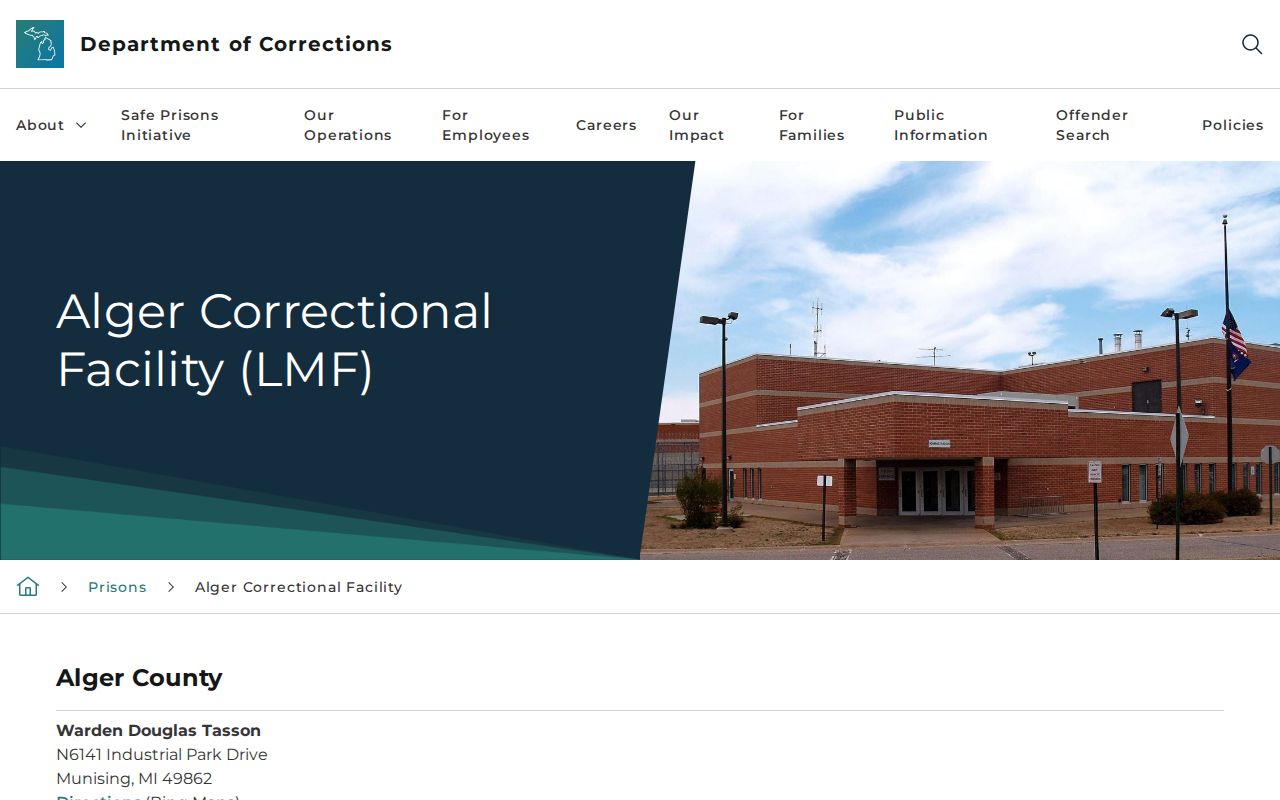
The captured official page is the facility contact and identity source. Release status still belongs in OTIS or the relevant MDOC record, not on a local daily-release list.
Separate Alger Jail and Prison
Alger County’s distinctive search problem is a name collision. Alger County Jail is run by the Sheriff and holds local detainees and jail-sentenced people. Alger Correctional Facility is a state prison run by MDOC. The Sheriff does not maintain LMF prisoner release files, and the county FOIA coordinator is not the custodian for an MDOC discharge certificate.
The reverse is also true. OTIS excludes people sentenced only to a county jail and is not the correct source for a local bond release. If the person moved from the county jail to LMF after a felony judgment, build a chain from the court judgment to the Sheriff transfer form and then the OTIS prisoner entry. That chain shows continued custody, not a community release.
| Question | Alger County Jail | Alger Correctional Facility |
|---|---|---|
| Operator | Alger County Sheriff | Michigan DOC |
| Primary record | Booking and release entry | OTIS and MDOC file |
| Records request | Alger County FOIA | MDOC FOIA |
| Release date | Actual Sheriff timestamp | Date Paroled or Date Discharged |
Alger Offender Photos and Errors
OTIS may display an MDOC photograph when an electronic image exists. The image can have its own date and may not reflect current appearance. It is a corrections image, not necessarily a county booking photo from a different arrest. A photograph helps compare identity but does not prove release, parole, or discharge.
Corrections follow the source of the disputed fact. Court-derived OTIS errors go first to the sentencing court. Supervision status or office errors go to the assigned parole or probation office. MDOC updates OTIS when properly directed through the court order or supervising agent. A set-aside can lead to removal by law, while an ordinary discharge normally remains public for the stated three-year OTIS window.
The Alger County released-inmate search compares all local, state, court, federal, and immigration channels. It is useful when the last known custody system is uncertain.
Note: Record the OTIS access time because assigned locations, release dates, supervision status, and public scope can change.
Alger Prison Release Documents
Release planning can create records that answer different parts of the event. The Parole Board decision shows the authorization and conditions under review. The Parole Release Unit coordinates the approved date, term, and special conditions. OTIS supplies the public status snapshot. A discharge certificate is the stronger target when the question is whether MDOC jurisdiction has ended. None should be replaced by a screenshot of a search result when certified proof is required.
MDOC also states that official identity documents held in the prisoner Record Office file can be given to the prisoner at parole or discharge. That is a state-prison process and does not establish how Alger County Jail returns property. Questions about an LMF document should go to the facility or MDOC records route. Questions about a county booking, bond, or jail property form belong with the Sheriff.